For pregnant women

THE COLUMBUS EGG: A RECOMMENDED FOOD DURING PREGNANCY

During pregnancy, the need for omega-3 and protein is much higher. While proteins will preserve the mother’s muscle mass, omega-3s are essential for both the pregnant woman and the unborn child. In particular, they will :

  • Help protect against gestational diabetes (1 in 10 pregnant women)
  • Preventing premature babies (5 to 7% of births in Europe)
  • Prevent postpartum depression (5-10% of women)

How much omega-3 does a pregnant woman need during pregnancy?

It is important to know that omega-3s are divided into :

  • plant-based omega-3s (ALA) and
  • animal omega-3s (DHA + EPA).

The recommended daily intake of omega-3 fatty acids for adults is :

  • 2 g of ALA and
  • 250 mg of DHA + EPA.

For a pregnant woman, an additional daily intake of 200 mg of DHA is necessary during pregnancy and breastfeeding, i.e. 450 mg of DHA + EPA.
These omega-3s, of animal origin, are generally found in oily fish such as salmon, sardines, mackerel and herring, but also in eggs. However, the Belgian High Council of Health recommends that pregnant women limit their consumption because of the risk of high levels of pollutants and heavy metals.

  • A pregnant woman needs an intake of 450mg of DHA per day.
  • A conventional egg provides between 15 and 60 mg of DHA.
  • A Columbus egg provides around 100 mg of DHA, i.e. almost 25% of the recommended daily intake for pregnant women, without the risk of the baby absorbing pollutants. 

MAIN BENEFITS OF OUR EGGS FOR PREGNANT WOMEN
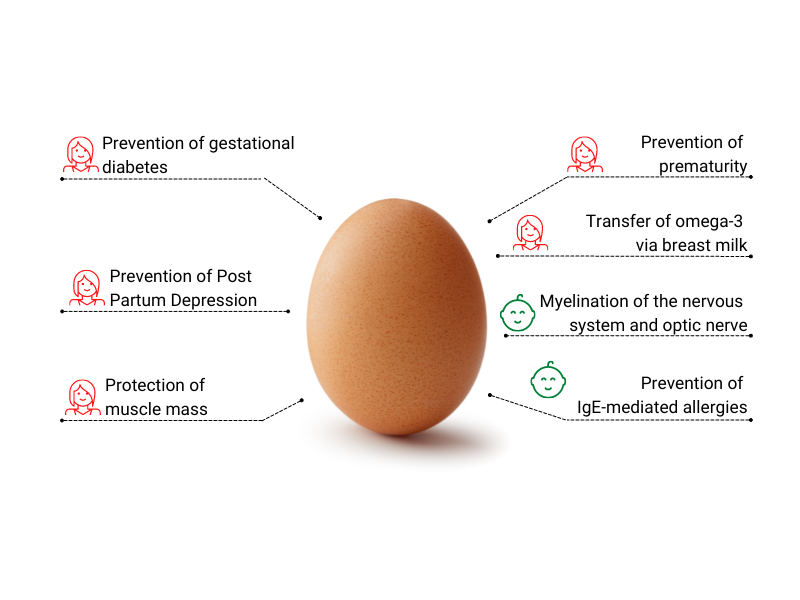
  • For pregnant women, regular consumption of Columbus eggs supports omega-3 intakes. And these are important to help protect against gestational diabetes, prevent prematurity and postpartum depression.

  • And it is not only in pregnant women that DHA is important. It is just as important in the foetus, where it is involved in the development of the brain and the retina (the sensitive organ of vision), particularly in the third trimester when the brain weight increases from 75 to 400 g. Insufficient intake could affect the baby’s cognitive development. The developing brain stores large amounts of DHA and a foetus needs about 75 mg of fat per day for brain development.

Gestational diabetes affects 1 in 10 pregnant women. The risk increases with the mother’s age, obesity and family history of type 2 diabetes.
However, a specific diet can significantly reduce these risks. Omega-3s once again play a beneficial role.
A meta-analysis of several studies that aimed to explore the influence of omega-3 fatty acids on gestational diabetes was conducted in 2019. The researchers conclude that omega-3 fatty acids are associated with a significant reduction in fasting blood glucose, insulin resistance and inflammation in patients with gestational diabetes. This explains the complementary needs of the pregnant woman.
Mothers-to-be with gestational diabetes should not hesitate to consult a nutritionist or dietician. Dietary advice is essential to improve treatment outcomes in these patients.

The incidence of prematurity is 5-7% in Europe. Studies show that regular consumption of omega-3 could reduce the risk of premature birth and of giving birth to an underweight baby (< 2.5 kg).
Derivatives of omega-3 acids play a role in regulating gestational age and childbirth. Increasing the intake of omega-3 fatty acids during pregnancy would reduce the risk of preterm birth.

After childbirth, the hormonal balance of the mother changes abruptly, which can lead to, among other things, post-partum depression. This depression, also known as the baby blues, affects 10% to 15% of women.
As the omega-3 fatty acid DHA is responsible for maintaining the production of serotonin, also known as the ‘happy hormone’, researchers have assumed that there may be a link between omega-3 fatty acids and postpartum depression. Their studies showed that women with postpartum depression had significantly lower levels of DHA than the control group.
There is therefore a direct link between EPA+DHA levels and the baby blues, and the higher the level in the depressed person, the more likely it is that the depression will be cured.

EATING RAW EGGS DURING PREGNANCY ?

To avoid any health risk, it is recommended that : 

  • To consume eggs within 9 days of the date of laying for soft-boiled eggs (cooked for 3 to 5 minutes) or in home-made preparations containing raw eggs (chocolate mousse, mayonnaise, ice cream, etc.).

  • Eat homemade raw egg products the same day and keep them refrigerated. If there is any left over, throw it out!

  • Also, avoid eating homemade raw egg dishes in restaurants or at friends’ houses.

  • For cooked eggs, care should be taken not to exceed the recommended use-by date and to cook them thoroughly (omelette, hard-boiled or fried eggs with a well-seared yolk).

Sources :

Dietary Reference Values for nutrients (EFSA, Septembre 2017)
Conseil Supérieur de la Santé (CSS) No. 9285, September 2016

Middleton, P., Gomersall,J.C., Gould, J.F., Shepherd,E., Olsen, S.F., & Makrides, M. (2018). Omega‐3 fatty acid addition during pregnancy. Cochrane Database of Systematic Reviews, 11.DOI: 10.1002/14651858.CD003402.pub3

Warstedt K., Furuhjelm C., Fälth-Magnusson K., Fagerås M., Duchén K. (2016) High levels of omega-3 fatty acids in milk from omega-3 fatty acid-supplemented mothers are related to less immunoglobulin E-associated disease in infancy. In: Acta Paediatrica, 105(11): 1337-1347.

Omega 3 allaitement allergies – Consulter l’étude originale ici : http://bit.ly/2zgkIBq

Elshani, B., Kotori, V., & Daci, A. (2021). Role of omega-3 polyunsaturated fatty acids in gestational diabetes, maternal and fetal insights: current use and future directions. The journal of maternal-fetal & neonatal medicine : the official journal of the European Association of Perinatal Medicine, the Federation of Asia and Oceania Perinatal Societies, the International Society of Perinatal Obstetricians, 34(1), 124–136. https://doi.org/10.1080/14767058.2019.1593361

Robertson, E., Grace, S., Wallington, T., Stewart, D.E. (2004). Antenatal risk factors for postpartum depression: a synthesis of recent literature. General Hospital Psychiatry, Volume 26, Issue 4, 289-295. https://doi.org/10.1016/j.genhosppsych.2004.02.006

Zhong, N., Wang, J. (2019). The efficacy of omega-3 fatty acid for gestational diabetes: a meta-analysis of randomized controlled trials, Gynecological Endocrinology, 35:1, 4-9, DOI: 10.1080/09513590.2018.1480716

Wellens, N., & Temmerman, M. (2009). Omega-3 vetzuren en zwangerschap. Master of Medicine in Medicine.

ALLEN K. G.,HARRIS M. A.: The role of n-3 fatty acids in gestation and parturition. Exp Biol Med (Maywood), 2001, 226, 498-506.

A WIDE RANGE

Discover the range of Columbus eggs, barn, free-range, jumbo or picnic eggs.
Delicious and good for your health.